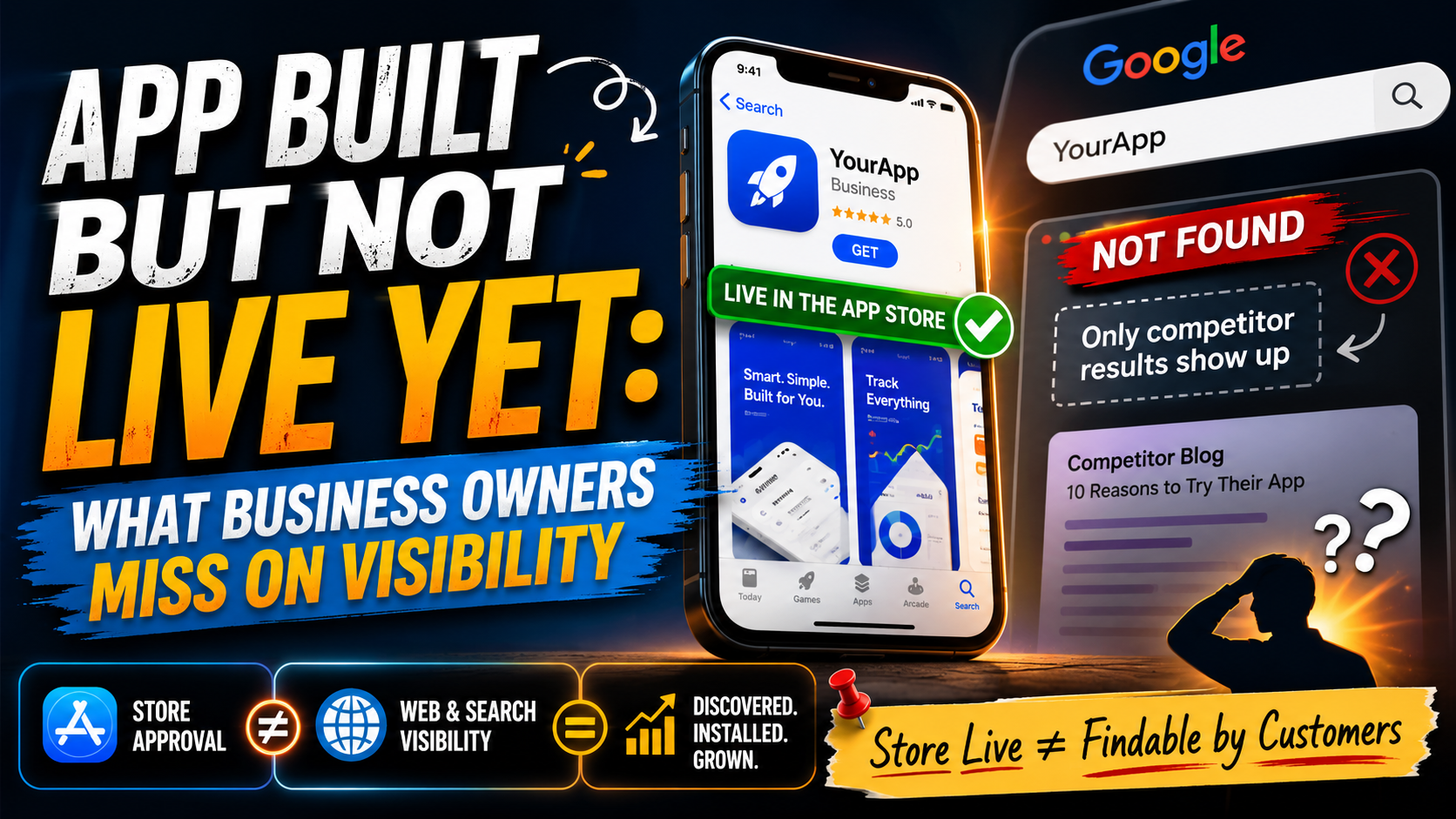
The app appeared in the App Store on Tuesday. On Wednesday marketing searched the product name on Google and found nothing except a competitor's blog post.
For founders and marketing leads, live in the store and findable by customers are different jobs. Confusing them is how teams burn ad budget on a launch nobody can discover. If you are commissioning mobile app development services, visibility should be part of launch planning, not a surprise in week two.
This guide is for business owners, not mobile engineers. It separates store presence from web discoverability and names checks you can run without reading crash logs. For what stores ask during submission week, see what App Store and Play Store launch ask of business owners.
"Live" means different things on different surfaces
|
Surface
|
What "live" usually means
|
Common owner assumption
|
|
App Store / Play Store
|
Approved listing, installable build
|
Customers will find it without extra work
|
|
Your marketing website
|
Landing page indexed (Google has added it to search results), forms work
|
Same team that shipped the app handled this
|
|
Branded Google search
|
People typing your app name see you
|
Happens automatically at approval
|
Assumption three fails most often. Store approval does not create an indexed marketing site or fix missing analytics.
If someone searches your app name and only competitors appear, check that a landing page exists, that your sitemap lists it, and that Google Search Console (Google's free tool showing which pages Google knows about) is set up for your domain.
Checklist: store listing vs customer discovery
Store presence (you may already have this)
- App installable from both stores you promised (if applicable)
- Store description matches what v1 actually does
- Support URL and privacy policy load on mobile
- Review responses planned for first 48 hours
Web and search visibility (often skipped)
- Dedicated landing page live with clear install links
- Page shows up in Google Search Console (free tool to see if Google knows your page), or you intentionally used noindex (telling Google not to show the page) and understand why
- Branded search shows your domain, not only third-party mentions
- UTM tags (tracking parameters on links) on store buttons so marketing knows what converts
- Press or partner pages use the same product name as store listings
If ads point to a homepage that never mentions the app, you are paying for confusion.
The cost of waiting
Every week without a findable landing page:
- Paid campaigns send traffic nowhere useful
- Sales demos link to store pages without context
- Support answers the same "where do I download?" question manually
- SEO equity goes to aggregators or competitors mentioning your category
None of that is fixed by another sprint of features. It is fixed by treating launch visibility as a phase, the same way engineering treats QA.
Why a phase map helps
Most stalls are not one bug. They are unnamed handoffs: build finished, backend not production-ready, store forms incomplete, marketing site never scoped. When stakeholders ask why the app is built but not live in the sense customers experience, the answer is usually a missing phase, not laziness.
We wrote a plain-language map from idea through store launch for non-technical buyers: why your app is built but not live yet. It does not replace store checklists; it names the journey so quotes and timelines stop hiding submission and visibility work.
Practical takeaway
Before you announce launch, ask two questions:
- Can a new customer install the app from the store we promised?
- Can someone who hears about us online find a credible page and a path to install within one click?
If either answer is unclear, you are not fully live yet, even if engineering marked the build done.
Which gap hit you last: store approval, landing page indexing, or branded search?