Your developer mentioned JSON-LD. Your agency sent a schema checklist. Google Search Console shows "Enhancement" warnings you do not understand. Meanwhile someone on the team asks whether you need LocalBusiness markup on every service page.
Structured data is not magic rankings dust. It is a machine-readable way to tell search engines who you are, what you offer, and where you operate, so results can show richer snippets when Google chooses to use them.
The confusion usually comes from picking the wrong schema type, duplicating conflicting signals, or stuffing location keywords into visible copy instead of using schema and Google Business Profile correctly.
We help teams implement technical SEO for business websites with schema that matches how they actually operate. This guide compares Organization and LocalBusiness, when each fits, and what belongs elsewhere (footer, contact, GBP).
What Structured Data Does (And Does Not Do)
Does:
- Clarifies entity information (business name, logo, URL, contact methods)
- Can enable rich result eligibility for some page types (FAQ, how-to, product, etc., when content and policy allow)
- Supports consistency between your site, citations, and Google Business Profile
Does not:
- Guarantee rich snippets or higher rankings
- Replace a verified Google Business Profile or consistent NAP in directories
- Fix crawl blocks, thin content, or broken redirects
Treat schema as supporting evidence, not a substitute for findable pages and useful copy.
Organization Schema: When It Fits
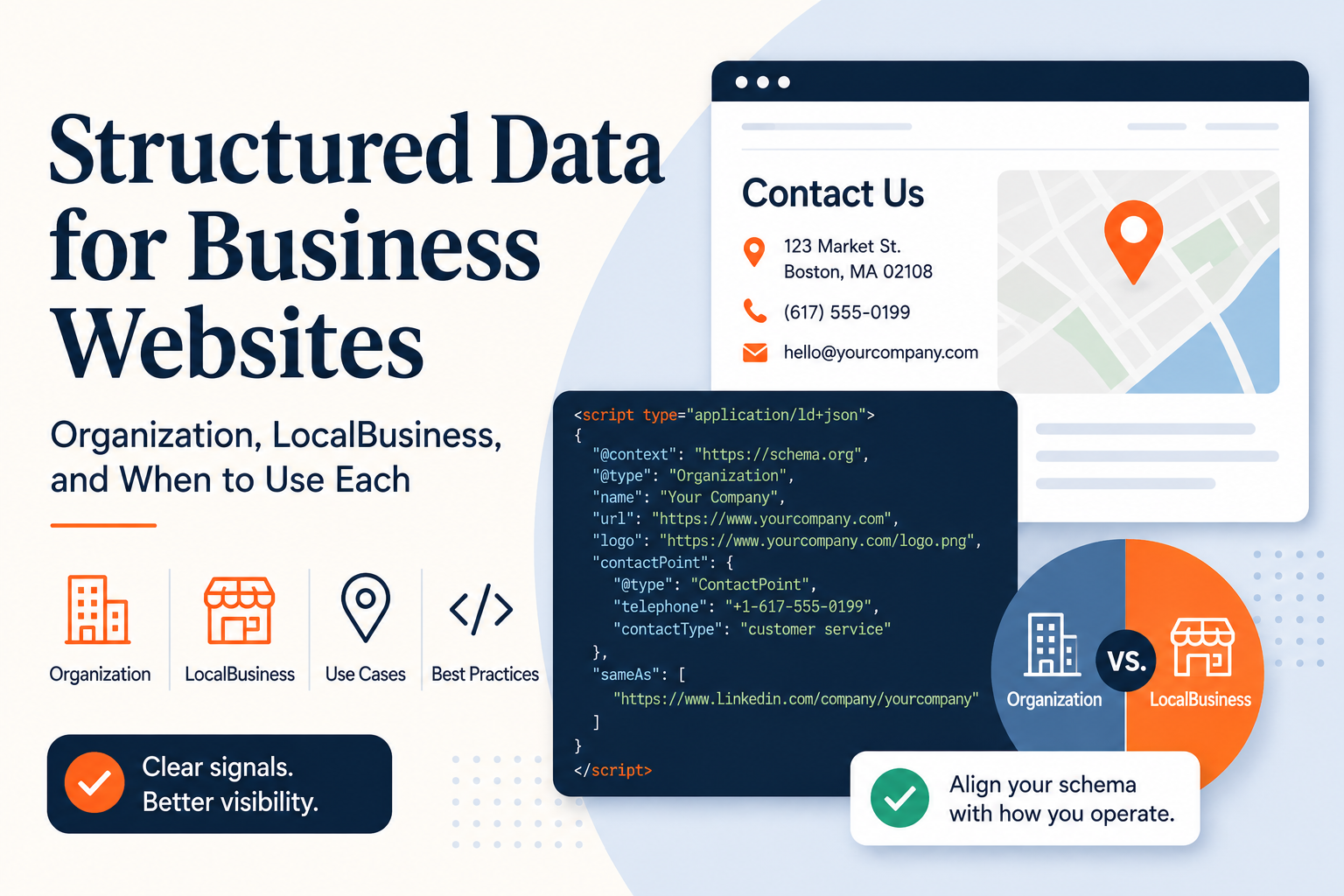
Use Organization (or a more specific subtype like ProfessionalService when accurate) when you want to describe the company as an entity site-wide or on core brand pages.
Typical properties:
name, url, logocontactPoint (phone, contact type, area served)sameAs (official social profiles)address when you have a real postal address to publish
Good fit for:
- Homepage or
/company when you serve clients globally and locally
- B2B firms where the primary story is expertise and delivery, not a retail storefront
- Sites where one clear HQ address exists and matches citations
Organization alone is often enough when you are not a walk-in location business and your local presence is proven through contact, footer, GBP, and citations rather than repeated city names on every service URL.
LocalBusiness Schema: When It Fits
LocalBusiness (and subtypes like ProfessionalService under the local branch) adds place-oriented signals: physical location, hours, geo coordinates when appropriate.
Good fit for:
- Businesses where customers expect a map, hours, or in-person visits
- Single-location service firms with a published address on contact pages
- Pairing with a verified Google Business Profile that matches the same NAP
Use carefully when:
- You are fully remote with no public office (avoid fake addresses)
- You serve many regions but only have one HQ (use
areaServed honestly, not a city list in every title)
- Franchise or multi-location brands need separate LocalBusiness entries per location, not one blob on the homepage
Organization vs LocalBusiness: Quick Decision Table
|
Question
|
Lean toward Organization
|
Lean toward LocalBusiness
|
|
Primary buyer is global / remote?
|
Yes
|
Rarely
|
|
Walk-in or local appointments matter?
|
No
|
Yes
|
|
One HQ address on contact, matches GBP?
|
Either; Organization + address block
|
Strong fit
|
|
Multiple physical locations?
|
Parent Organization + per-location pages
|
Per-location LocalBusiness
|
|
Service pages need schema?
|
Service or WebPage + site Organization
|
Same; do not paste LocalBusiness on every URL
|
Many business sites use Organization on the site plus LocalBusiness on contact or location pages when a physical office is part of the offer. That is cleaner than repeating LocalBusiness JSON-LD in every footer include without thought.
What Not to Do
Do not stuff location into service page H1s to "support" LocalBusiness
Google and buyers both suffer when every service title becomes a directory listing. Keep service pages globally readable. Put address and service area in contact, footer once, schema, and GBP.
Do not publish schema that contradicts your live site
Common mismatches:
- Schema phone differs from contact page
url in JSON-LD points to staging- Address in schema does not match Google Business Profile
openingHours left from a template when you are appointment-only
Search engines notice inconsistency. So do customers who call the wrong number.
Do not copy competitor schema blindly
Your entity, address model, and service area are yours. Copy-pasting a competitor's LocalBusiness block with your name swapped in creates the wrong subtype and wrong properties.
Minimum Viable Schema for a Business Site Launch
Before launch, confirm:
- One authoritative Organization block (or WebSite + Organization) with correct
name, url, logo
- Contact page NAP matches footer and GBP
- LocalBusiness only where a real location is part of the offer, with matching address
sameAs only for profiles you control- Validate with Google's Rich Results Test or Schema Markup Validator; fix errors, treat warnings as review items
Optional when content supports it: FAQ, Article, or Service schema on specific URLs. Add those per page type, not as a site-wide dump.
How Schema Fits With Google Business Profile
Schema and GBP are complementary:
- GBP: verified listing, reviews, map pack eligibility, service areas you configure in the product
- Schema: on-site machine-readable entity data for crawlers
They should agree on name, address, phone, and primary URL. They should not duplicate conflicting cities across every page body.
After Launch: What to Monitor
- Search Console Enhancements (if eligible types appear)
- Unparsed structured data errors after template or CMS changes
- Citation audits when phone or address changes (update schema the same day)
Schema maintenance is small effort compared to redirects after a redesign, but only if someone owns it when the marketing site updates.
Practical Takeaway
Pick Organization for who you are as a company. Add LocalBusiness where a genuine location belongs in the customer journey. Keep location proof in contact, footer, GBP, and citations. Keep service pages focused on the offer.
If you are unsure whether your current JSON-LD matches how you operate, a short structured data review beats adding more types you do not need.
When you are ready to align schema with launch or redesign work, scoping a structured data review with your dev partner is a reasonable first step.
What schema warnings have you seen in Search Console that turned out to be harmless versus urgent?