The board slide says "digital transformation by Q4." Operations still reconciles orders in a spreadsheet. IT has a list of seventeen tools that "might integrate someday." Nobody owns the cutover plan if the new system goes live wrong.
That gap is common. Digital transformation is not a purchase order. It is a sequence of decisions about data, process, and people. Buying ERP or commissioning custom system development before readiness work is done often means paying to automate confusion faster.
This guide is for owners and ops leads triaging whether the organization is ready for a major systems program, not whether a vendor demo looked polished. If you have already fixed day-to-day bottlenecks (duplicate entry, inbox approvals, spreadsheet bridges), you are closer to a real build. If not, start there before an RFP.
We help teams scope digital transformation and custom system development when readiness and delivery need to align. These five signals are what we check before anyone signs an implementation quote.
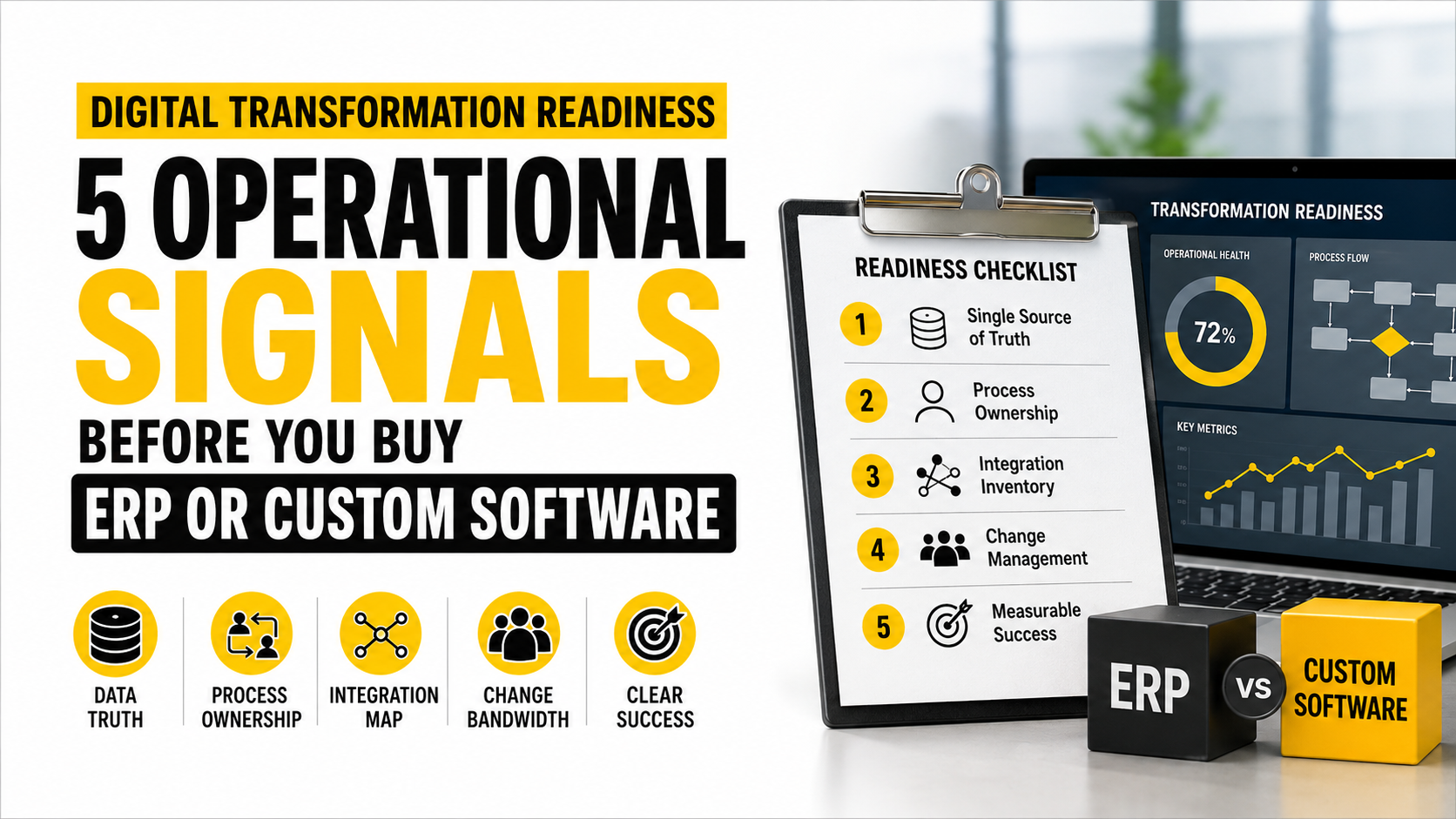
Signal 1: No Single Source of Truth for Core Data
ERP and custom platforms assume you know which system owns customer, order, inventory, and financial truth.
Symptoms:
- The same customer record differs between CRM, billing, and support
- Reports disagree because each team exports with different filters
- "Official" data lives in a spreadsheet someone updates on Fridays
Readiness fix: Name one system of record per entity. Document which fields are authoritative and who may edit them. Retype once if needed until integration scope is clear.
Not ready when: Leadership debates which number is "real" in every steering meeting.
Signal 2: Process Owners Exist Only on Org Charts
Transformation programs fail when steps span departments and no one can explain the end-to-end flow.
Symptoms:
- Handoffs happen in chat, not in a shared queue
- "That is finance's problem" blocks a customer-facing fix
- When a key person is on leave, the process stops
Readiness fix: Assign one owner per critical process. They document happy path and exceptions on one page. If they cannot explain it in ten minutes, software will encode confusion.
Not ready when: Nobody can draw the current flow without apologizing for exceptions.
Signal 3: Integration Inventory Is a Wish List, Not a Map
System integration work needs a honest list of what connects today, what must connect on day one, and what can wait.
Symptoms:
- Integrations are "the IT guy's script" with no documentation
- New tools are bought without asking what they must sync to
- Failure modes are unknown until month-end close breaks
Readiness fix: Inventory systems, data flows, and batch vs real-time needs. Mark critical paths (billing, fulfillment, payroll) separately from nice-to-have dashboards.
Not ready when: The integration diagram is a slide from a sales demo, not your production reality.
Signal 4: Change Management Bandwidth Is Already at Zero
Go-live is not the finish line. Teams need time for training, parallel runs, and exception handling.
Symptoms:
- Every project is "urgent" and nothing gets retired
- Frontline staff learn new tools from PDFs emailed the night before launch
- Leadership expects the old process and the new system to run forever in parallel with no extra headcount
Readiness fix: Block calendar for UAT, training, and hypercare weeks. Name who decides exceptions during cutover. Retire at least one manual workaround as a condition of launch.
Not ready when: The plan assumes users will "figure it out" because the vendor trained once.
Signal 5: Success Criteria Are Vague or Vanity
"We need ERP" is not a metric. Neither is "be more digital."
Symptoms:
- ROI slides use industry averages, not your baseline costs
- No agreed error rate, cycle time, or rework measure before purchase
- Success means "go-live" even if teams revert to spreadsheets afterward
Readiness fix: Pick three to five measurable outcomes (hours saved, error reduction, faster close, fewer tools). Baseline them before vendor selection. Tie payment milestones to adoption, not only installation.
Not ready when: The steering committee cannot agree what "done" looks like in plain numbers.
Readiness vs Purchase: A Simple Triage Table
|
If you see…
|
Fix first
|
Buy or build when…
|
|
Conflicting data across tools
|
System of record + field ownership
|
Volume makes manual reconciliation more expensive than integration
|
|
Unclear handoffs
|
Named process owners + one-page flows
|
Repeatable steps need audit trails or SLAs
|
|
Mystery integrations
|
Documented inventory + critical paths
|
APIs or sync are scoped with failure plans
|
|
No training time
|
Calendar + hypercare plan
|
Leadership funds parallel run and support
|
|
Vague goals
|
Baseline metrics + definitions
|
RFP ties scope to measurable outcomes
|
What Comes After Readiness
When these signals are green enough to proceed, the next decision is usually platform shape: packaged ERP implementation vs a custom system build. That is a different question from daily bottlenecks or hiring model. A companion checklist on [ERP implementation vs custom system questions for buyers](*(pending Blogger publish URL)*) walks through seven due-diligence questions once you are ready to compare proposals.
Cloud hosting and migration sequencing matter on either path. Treat readiness as the gate, platform choice as the fork, and migration order as the execution plan.
Practical Takeaway
Digital transformation services earn their cost when they remove repeatable work with clear rules and owned data. They fail when they wrap broken handoffs in enterprise licensing.
Fix source of truth, ownership, integration maps, change bandwidth, and success metrics before you buy ERP or sign a custom build. Your RFP will be shorter. Your implementation partner will thank you.
Which signal on this list would block your go-live if you ignored it for another quarter?
If you want a short readiness review before an ERP or custom build, we can help you sort readiness gaps from scope that belongs in a delivery plan.